Thursday, October 13, 2011

Mountain Film Festival Comes to Film Society of Lincoln Center, Oct. 21-23


Friday, October 21st, and running all weekend long, the Film Society will host a special film festival: MountainFilm Festival. This unique and rich program provides a varied slate of shorts and features emphasizing the wonders of adventure, exploration, sports, and environment. The festival also highlights human rights and activism through food, environment, and community development. MountainFilm Festival is filled with screenings, panels, and some complimentary discussions regarding these intriguing subjects, with appearances from the program's filmmakers and activists.

Friday, September 23, 2011

Forty-six Days Cycling through Iceland… with Kids


EXPEDITION FOCUS
Trip Report by Charles Scott
September 2011
www.icelandbikeadventure.com


“Are you crazy?” I often got this reaction while cycling 1,500 miles across Iceland with my 10-year old son Sho and 4-year old daughter Saya to raise money for a United Nations environmental campaign. Sho pedaled behind me on a connected trailer cycle, and Saya sat snugly behind him strapped in a bike trailer. We carried about 100 pounds of gear.

“Crazy” is a relative term, but not necessarily pejorative. It might describe any act that includes seemingly unnecessary hardships, falls outside of mainstream behavior, or challenges the status quo. That’s why I usually answered the question with a smile and a simple, “Yes.”

Yes, I’m crazy and lucky. Cycling for forty-six days with my kids through this dramatic, rugged, inspiringly beautiful country offered a remarkable contrast to our mainstream life in the dense urban mess of New York City, where I feel disconnected from nature’s rhythms. Most days, I sit in a climate-controlled environment staring into a computer screen for hours on end. And I am bombarded by constant temptations to consume material goods. In addition to raising money for a United Nations tree planting campaign, the trek through Iceland was an attempt to share with my kids an experience of unspoiled nature, a place where humans have not yet subjugated their surroundings.

Many people were concerned about the welfare of my kids, asking me, “Don’t you think it’s dangerous to ride with your kids on busy roads with passing cars?”
Answer: We trained on the streets New York City. If you wear reflective gear and don’t go too fast, I think it’s reasonably safe.

Several asked, “Won’t your daughter get bored, riding for hour after hour in a bike trailer?”

Answer: Yes. What’s wrong with being bored? That’s what imagination is for.

Others asked, “Isn’t it too much to expect a ten-year old boy to cycle for six weeks, often through rain and cold wind?”

Answer: Sho didn’t think so.

He and I cycled across Japan, 2,500 miles in 67 days, when he was eight years old. And he’s already looking forward to another adventure cycling trip next summer.

He regularly tells people, “A kid can do a whole lot more than most adults think.”
Arriving on the summer solstice in Reykjavik, latitude 66 degrees north, it took us a few days to get used to the near-constant daylight.

But the magical experience of cycling beneath a midnight sun made up for the mild disruption to our sleep patterns, and served as a real-world science lesson for my kids.

Sho marveled at the phenomenon and explained the earth’s tilt to Saya.

But at four years old, she preferred an anthropomorphic explanation: “The sun doesn’t want to miss summer, so it stays up all night.”

The ride through Iceland was like taking an inspirational and educational field trip. Sho and Saya discovered a tiny carnivorous mountain plant, snacked on wild crow berries while hiking past majestic waterfalls, explored a massive glacier, witnessed the powerful calm of a humpback whale diving and resurfacing, and scaled the edges of towering, vertigo-inducing bird cliffs that overlooked an endless, sparkling ocean expanse. We became enthusiastic bird watchers, identifying oyster catchers, puffins, snipes, eiders, razorbills, and arctic terns.

While cycling through the east fjords, we came across a scene I will not soon forget: fifteen whooping swans coasting serenely over the sea, large alabaster forms stretching out long necks to take gentle sips of the glowing water. We ate lunch amid vast lava fields strewn with black boulders and belching sulfur vents. We rode sturdy Icelandic horses, camped in the wild, and awoke to the cries of arctic terns hunting above the softly lapping ocean surf nearby.

While inspired by Iceland’s raw beauty, I also felt small and fragile in the face of nature’s power and indifference. A glacial flood triggered by a volcano washed away the road we had traversed just days earlier. Sometimes the headwind was so strong that we struggled to maintain a pitifully slow pace. Sho and I shivered, despite many layers of clothing, when the temperature dropped to the low 40’s F, and rain soaked through our “waterproof” gloves and socks (my daughter stayed safe and warm in her trailer). Our answer was to pedal harder to stay warm. I told my son, “This ride was supposed to be hard. Sometimes an adventurer just suffers for a while.”

We met a stream of friendly people. Passing motorists stared at our unusual bike setup and often gave us a thumbs up.

Some tourists pulled over to snap our picture as we cycled past. Sho usually gave them a wave, while Saya made crazy faces and stuck out her tongue. Locals who heard about our charity ride offered us places to stay, gave us discounts or free entry to museums, and commiserated with us about the wind and rain.

Many people told us about recent changes in the country’s climate. A group of scientists we met explained that, while Iceland’s glaciers are retreating steadily, the most dramatic change is happening beneath the surface, as the ice is hollowed out by ever increasing amounts of flowing water.

A fisherman told me that, since 1980, he has measured a 2 degree Celsius increase in the average temperature of the water where he fishes. In the past few years, great numbers of mackerel have begun to appear off the coast of Iceland, moving north in search of colder water and causing tensions between Iceland and the EU over fishing quotas. People speculate that one reason for the recent decrease in the local puffin population may be that the encroaching mackerel are eating the sandeels that are the puffins’ primary food source. When we visited the Westman Islands, previously home of the world’s largest puffin colony, we learned that the vast majority of nests were empty this year.

Living in New York City, it is easy to ignore or minimize the impact of these climatic changes.

But as I cycled through a country in which the forces of nature so clearly held sway, I felt a powerful and humble connection to the world around me. We cycled past baby sheep peeking out from behind a protective mother, or ducklings crowding close to their parents. We ducked below aggressive arctic terns swooping down from above to protect their young. Hearty shrubs and bright delicate flowers struggled to grow in harsh lava fields. I recognized in these animals and even in the plants the same resilience that I hope to cultivate in my children.

As we cycled along one of Iceland’s many dramatic fjords, Saya declared, “I’m in love with horses and arctic terns!” It is this sense of connection to the natural world, and a desire to treasure and protect the wilderness that remains, that I hope my children will internalize. It is something I hope we will all take to heart, treating the earth, and our brief time on it, as a gift to be cherished. Perhaps then we can begin to reverse the cycle of unsustainable living that has become our generation’s signature legacy.

Call me crazy.

Tuesday, September 13, 2011

Lowell Thomas Awards Dinner, Oct. 15, St. Louis


The St. Louis chapter of The Explorers Club will host the Lowell Thomas Awards dinner at the Missouri History Museum (Forest Park, 5700 Lindell Boulevard) on Oct. 15th. This is the first time the award, established in 1980, has been given outside of New York.

The theme of the dinner is “Exploring the World’s Greatest Mysteries.” Master of Ceremonies is Explorers Club Honorary Chairman Jim Fowler, former star of the TV show Mutual of Omaha Wild Kingdom.

Previous recipients of The Lowell Thomas Award include Isaac Asimov, Clive Cussler and Wade Davis; astronauts Buzz Aldrin, James Lovell and Kathryn Sullivan; and mountaineer Sir Edmund Hillary.

This year’s honorees are:

• Edmundo R. Edwards, Patricia Vargas Casanova, Claudio P. Cristino for studies of the culture of Eastern Polynesia, and the enigmatic moai that stand on the shores of Easter Island.

• Albert Yu-Min Lin, Ph.D., a research scientist attempting to find the tomb of Genghis Khan and protect a sacred region of Mongolia.

• Thomas E. Levy, Ph.D., who has revolutionized the dating of the Biblical land of Edom, pushing the sequence some 500 years earlier than the scholarly consensus – and brought researchers closer than ever before to testing for the potential existence of “King Solomon’s Mines.”

• Brent S. Stewart, Ph.D., J.D., a senior research scientist praised for studies of the mysterious whale shark and other migratory marine species.

• William C. Stone, Ph.D., one of the world’s foremost expeditionary cavers and a proponent of using technology to help explorers survive and thrive as they challenge new frontiers.

• Kenneth R. Wright and Ruth M. Wright, J.D., partners whose work on water conservation has brought enduring benefits to the environment, water resources, and communities in both North and South America.

Tickets start at $200 and can be ordered through http://ltad2011.explorers.org/

Monday, September 12, 2011

Vern Tejas’ 50th Summiting of McKinley Probably a Record


Guide Vern Tejas logged his 50th summit of Mount McKinley this summer, prompting an obvious question: Does that make him the ruler of North America's highest roost? Beth Bragg of the Anchorage Daily News (July 20) reports officials with the National Park Service don't know if anyone has been to the top of McKinley more often than Tejas, because they didn't begin tracking summits until 1995. They think Tejas, who boasts numerous claims to fame gained in the Alaska Range and beyond, probably owns the record for the most McKinley summits. (See EN, September 2009).

Tejas, 58, a guide for Alpine Ascents International, said his first two McKinley summits came in 1978, one as a client and one as a guide. An impressive – but not unprecedented – four summits came in 1988, when Tejas became the first person to complete a solo climb of the mountain in the winter. No. 50 came June 30, when he was the guide of an eight-person team that made it to the summit.

"Mt. Vinson in Antarctica would be my next most climbed mountain, however it's not even close to Denali at a mere 27 summits," Tejas tells the Daily News.

In 1988, Tejas made it to the top of McKinley four times, an achievement that began in March when he became the first person to make a successful solo winter ascent of the mountain. "My endless winter," Tejas calls it.

Tejas guided adventurer Norman D. Vaughan in 1994 when, at age 89, Vaughan climbed a 10,320-foot Antarctic peak that Admiral Richard Byrd named in his honor 65 years earlier during their historic 1928-1930 South Pole expedition.

Tejas also continues to pursue adventures outside Alaska, but nothing inspires him like McKinley. "Denali is the most beautiful mountain in the world," he wrote, "and I want to climb it as long as I can – 65 summits when I am 65 sounds great to me. A nice round number."

Sunday, August 28, 2011

Jetman Video is Home Run for Breitling


In 2006, Swiss pilot Yves "Jetman" Rossy became the first man in history to fly like a bird, albeit with fiberglass and carbon fiber wings powered by kerosene-fueled engines. Since then he has crossed the English Channel and, most recently, flew over the Grand Canyon. This beautifully produced video has it all – great scenery of the Grand Canyon shot in May 2011, p.o.v. footage from his 190 mph flight, stirring Cirque du Soleil-like music (with even a pan flute thrown in), and lots of visual identification for Breitling, his sponsor. View it here: http://timetosignoff.com/video/?id=16545


Friday, July 29, 2011

The Explorers Club Discovers Its North Face


Members of The Explorers Club, the world renowned international exploration organization, discovered a bit of urban archaeology unseen for years – the North Face of their iconic Upper East Side headquarters named for famed broadcaster and Club member Lowell Thomas.

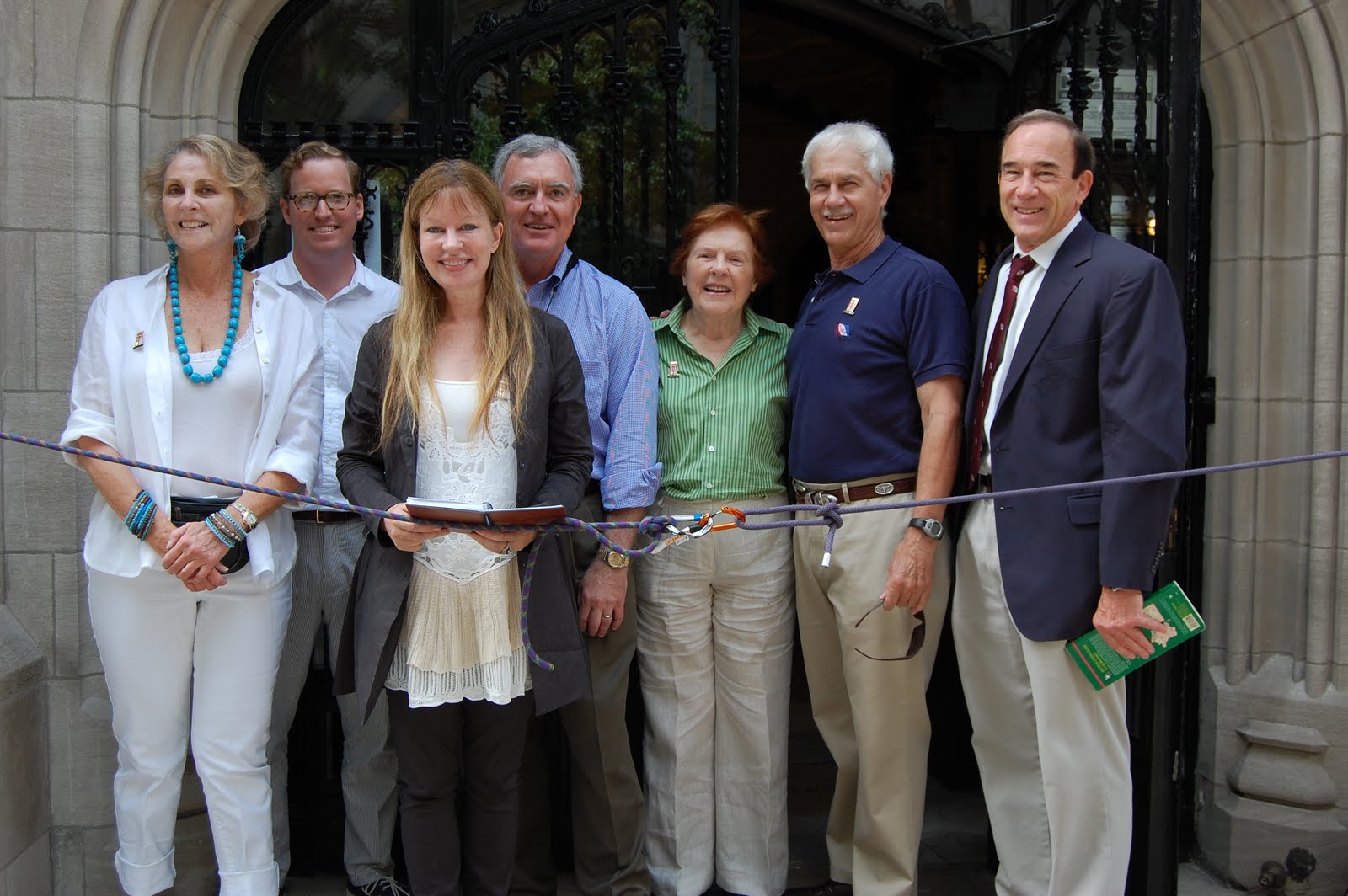
The 107-year-old Club celebrated completion of the restoration of its 46 East 70th Street north-facing façade, and removal of construction scaffolding, with a public open house on July 28. Immediately following the ribbon ceremony, a climber descended the east exterior wall of the six-story building, highlighting the next area of the building targeted for Phase II of the renovation project. The Phase II renovation will also focus on the Club’s outside terrace and a colonnade of particular historical import that dates from the medieval period, another portion of which is believed to be housed at The Cloisters.

Tuesday, July 26, 2011

Public Invited: Explorers Club Open House, July 28


Members and Public Discover
The Explorers Club “North Face”;
Celebration of completion of
Phase I Headquarters Renovation

Open House, Thursday, July 28,
11 a.m. to 5 p.m. – Public Welcome


NEW YORK, N.Y. (July 26, 2011) – Members of The Explorers Club, the world renowned international exploration organization, will soon discover a bit of urban archaeology unseen for years – the North Face of their iconic Upper East Side headquarters named for famed broadcaster and Club member Lowell Thomas.

The 107-year-old Club will celebrate completion of the restoration of its 46 East 70th Street north-facing façade, and removal of construction scaffolding, with a public open house starting with a ribbon cutting on Thursday, July 28, at 11 a.m. Immediately following the ribbon ceremony, a climber will descend the east exterior wall of the six-story building, highlighting the next area of the building targeted for Phase II of the renovation project. The Phase II renovation will also focus on the Club’s outside terrace and a colonnade of particular historical import that dates from the medieval period, another portion of which is believed to be housed at The Cloisters.

Upon taking office as president in 2009, Lorie Karnath ¬– the 37th president and second female president in the Club’s 107-year history – launched a fundraising campaign to raise capital to begin the much needed revitalization of the 100-year-old headquarters. This initial campaign has raised the most amount of money to date for the Club under one administration.

“As explorers our mission is to not only conduct field research and add to man’s body of scientific knowledge, but to help ensure cultural and historical preservation as well. In this instance, cultural preservation starts at H.Q.,” stated Karnath.

In addition to restoring the façade of the Jacobean revival mansion, Phase I of the renovation involved repairing 114 stained-glass windows; installing a new roof membrane; replacing limestone ribs on the exterior; and repointing the South and East façades.

A spectacular 3-1/2-story bay window was meticulously rebuilt with reinforced stone, cast and color matched to the original that had deteriorated beyond repair.

The initial building fundraising campaign “Preserve a Brick” called for $50 donations to preserve each brick. “Adoptions” of stained-glass windows were offered beginning at $5,000 each, supplementing the numerous donations received from private individuals as well as a number of foundations including the Mabel Dorn Reeder and Richard Olson Foundations.

Rarely Viewed Artifacts

Rarely viewed artifacts from the Club’s extensive collection will be displayed throughout the day. These will include fragments of matting used in the burial of 10th century Alaskan mummies; a Polar Capsule left at the North Pole by the 1986 Steger North Pole Expedition and recovered off the north coast of Ireland three years later; an axe from 1911 used in the construction of Robert Falcon Scott's base shelter in Antarctica; and a 1906 recording made by Robert E. Peary, who would successfully claim to reach the North Pole in 1909.

There will also be a solar display courtesy of event sponsor Eastern Mountain Sports where guests can charge their cell phones while viewing the building’s elegant interior.

The unveiling of the North Façade and open house will be followed that evening by a presidential picnic hosted by President Karnath to launch Phase II of the capital campaign (tickets required). Old Pulteney has prepared an appropriate whisky tasting for the event in celebration of the restored North Face of the Lowell Thomas Building, the Club’s polar traditions, and Old Pulteney’s current Arctic expedition, “Row to the Pole.”

For more information: www.explorers.org.