Monday, September 12, 2011

Vern Tejas’ 50th Summiting of McKinley Probably a Record


Guide Vern Tejas logged his 50th summit of Mount McKinley this summer, prompting an obvious question: Does that make him the ruler of North America's highest roost? Beth Bragg of the Anchorage Daily News (July 20) reports officials with the National Park Service don't know if anyone has been to the top of McKinley more often than Tejas, because they didn't begin tracking summits until 1995. They think Tejas, who boasts numerous claims to fame gained in the Alaska Range and beyond, probably owns the record for the most McKinley summits. (See EN, September 2009).

Tejas, 58, a guide for Alpine Ascents International, said his first two McKinley summits came in 1978, one as a client and one as a guide. An impressive – but not unprecedented – four summits came in 1988, when Tejas became the first person to complete a solo climb of the mountain in the winter. No. 50 came June 30, when he was the guide of an eight-person team that made it to the summit.

"Mt. Vinson in Antarctica would be my next most climbed mountain, however it's not even close to Denali at a mere 27 summits," Tejas tells the Daily News.

In 1988, Tejas made it to the top of McKinley four times, an achievement that began in March when he became the first person to make a successful solo winter ascent of the mountain. "My endless winter," Tejas calls it.

Tejas guided adventurer Norman D. Vaughan in 1994 when, at age 89, Vaughan climbed a 10,320-foot Antarctic peak that Admiral Richard Byrd named in his honor 65 years earlier during their historic 1928-1930 South Pole expedition.

Tejas also continues to pursue adventures outside Alaska, but nothing inspires him like McKinley. "Denali is the most beautiful mountain in the world," he wrote, "and I want to climb it as long as I can – 65 summits when I am 65 sounds great to me. A nice round number."

Sunday, August 28, 2011

Jetman Video is Home Run for Breitling


In 2006, Swiss pilot Yves "Jetman" Rossy became the first man in history to fly like a bird, albeit with fiberglass and carbon fiber wings powered by kerosene-fueled engines. Since then he has crossed the English Channel and, most recently, flew over the Grand Canyon. This beautifully produced video has it all – great scenery of the Grand Canyon shot in May 2011, p.o.v. footage from his 190 mph flight, stirring Cirque du Soleil-like music (with even a pan flute thrown in), and lots of visual identification for Breitling, his sponsor. View it here: http://timetosignoff.com/video/?id=16545


Friday, July 29, 2011

The Explorers Club Discovers Its North Face


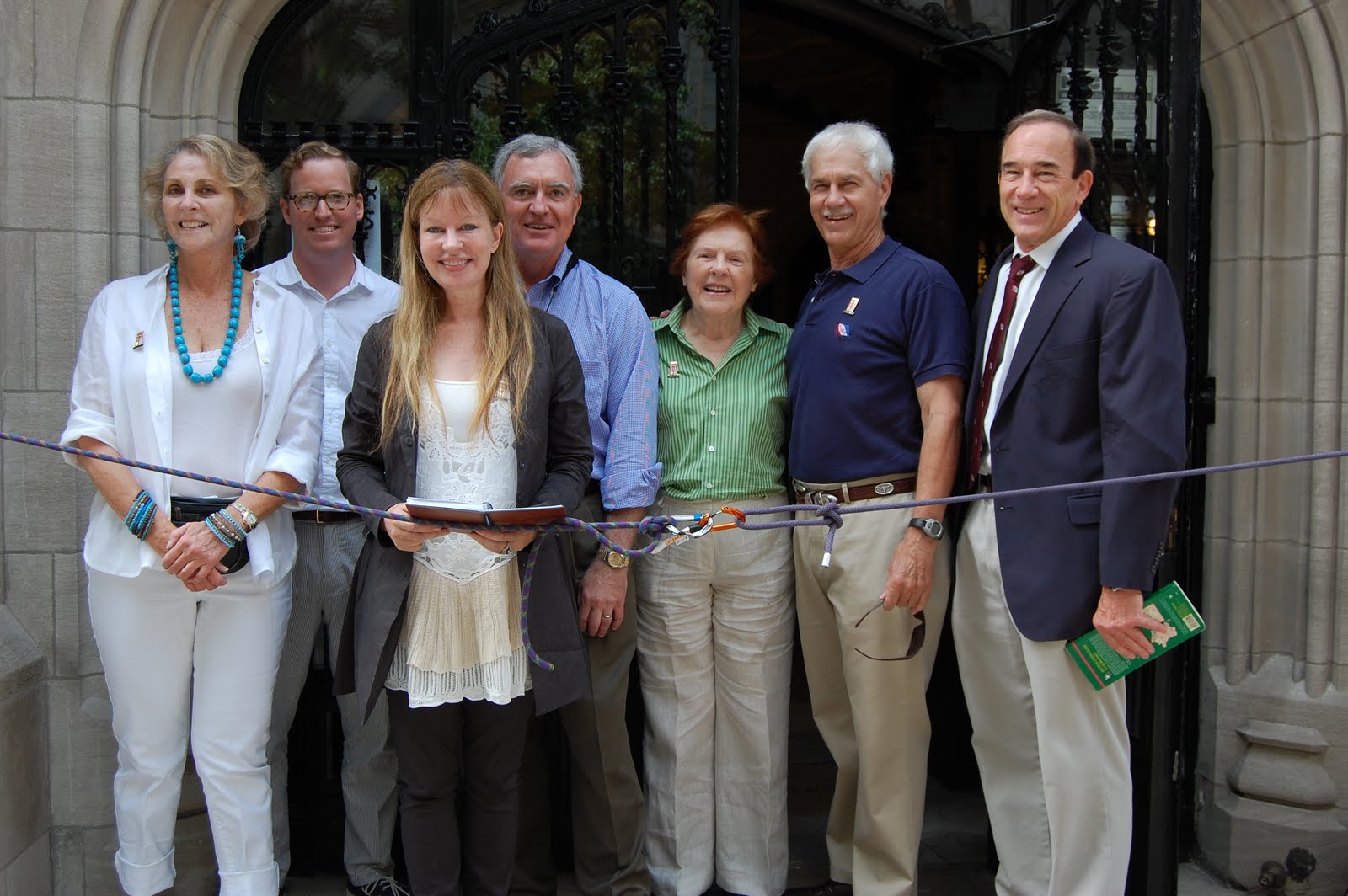
Members of The Explorers Club, the world renowned international exploration organization, discovered a bit of urban archaeology unseen for years – the North Face of their iconic Upper East Side headquarters named for famed broadcaster and Club member Lowell Thomas.

The 107-year-old Club celebrated completion of the restoration of its 46 East 70th Street north-facing façade, and removal of construction scaffolding, with a public open house on July 28. Immediately following the ribbon ceremony, a climber descended the east exterior wall of the six-story building, highlighting the next area of the building targeted for Phase II of the renovation project. The Phase II renovation will also focus on the Club’s outside terrace and a colonnade of particular historical import that dates from the medieval period, another portion of which is believed to be housed at The Cloisters.

Tuesday, July 26, 2011

Public Invited: Explorers Club Open House, July 28


Members and Public Discover
The Explorers Club “North Face”;
Celebration of completion of
Phase I Headquarters Renovation

Open House, Thursday, July 28,
11 a.m. to 5 p.m. – Public Welcome


NEW YORK, N.Y. (July 26, 2011) – Members of The Explorers Club, the world renowned international exploration organization, will soon discover a bit of urban archaeology unseen for years – the North Face of their iconic Upper East Side headquarters named for famed broadcaster and Club member Lowell Thomas.

The 107-year-old Club will celebrate completion of the restoration of its 46 East 70th Street north-facing façade, and removal of construction scaffolding, with a public open house starting with a ribbon cutting on Thursday, July 28, at 11 a.m. Immediately following the ribbon ceremony, a climber will descend the east exterior wall of the six-story building, highlighting the next area of the building targeted for Phase II of the renovation project. The Phase II renovation will also focus on the Club’s outside terrace and a colonnade of particular historical import that dates from the medieval period, another portion of which is believed to be housed at The Cloisters.

Upon taking office as president in 2009, Lorie Karnath ¬– the 37th president and second female president in the Club’s 107-year history – launched a fundraising campaign to raise capital to begin the much needed revitalization of the 100-year-old headquarters. This initial campaign has raised the most amount of money to date for the Club under one administration.

“As explorers our mission is to not only conduct field research and add to man’s body of scientific knowledge, but to help ensure cultural and historical preservation as well. In this instance, cultural preservation starts at H.Q.,” stated Karnath.

In addition to restoring the façade of the Jacobean revival mansion, Phase I of the renovation involved repairing 114 stained-glass windows; installing a new roof membrane; replacing limestone ribs on the exterior; and repointing the South and East façades.

A spectacular 3-1/2-story bay window was meticulously rebuilt with reinforced stone, cast and color matched to the original that had deteriorated beyond repair.

The initial building fundraising campaign “Preserve a Brick” called for $50 donations to preserve each brick. “Adoptions” of stained-glass windows were offered beginning at $5,000 each, supplementing the numerous donations received from private individuals as well as a number of foundations including the Mabel Dorn Reeder and Richard Olson Foundations.

Rarely Viewed Artifacts

Rarely viewed artifacts from the Club’s extensive collection will be displayed throughout the day. These will include fragments of matting used in the burial of 10th century Alaskan mummies; a Polar Capsule left at the North Pole by the 1986 Steger North Pole Expedition and recovered off the north coast of Ireland three years later; an axe from 1911 used in the construction of Robert Falcon Scott's base shelter in Antarctica; and a 1906 recording made by Robert E. Peary, who would successfully claim to reach the North Pole in 1909.

There will also be a solar display courtesy of event sponsor Eastern Mountain Sports where guests can charge their cell phones while viewing the building’s elegant interior.

The unveiling of the North Façade and open house will be followed that evening by a presidential picnic hosted by President Karnath to launch Phase II of the capital campaign (tickets required). Old Pulteney has prepared an appropriate whisky tasting for the event in celebration of the restored North Face of the Lowell Thomas Building, the Club’s polar traditions, and Old Pulteney’s current Arctic expedition, “Row to the Pole.”

For more information: www.explorers.org.

Friday, July 15, 2011

Explorers Club Flag Program is on Track


The Explorers Club is Monitoring Flags Like Never Before

©Copyright 2011 The Explorers Club

During the early part of the 20th century, Admiral Richard E. Byrd, an Honorary Member of The Explorers Club, carried three flags on his second Antarctic expedition in 1933-35. Yet by the mid-1950s, when their whereabouts were still a mystery, the celebrated explorer was reportedly miffed that Club officials would ask for them back. You can imagine the sense of unease when the Club president solicited board volunteers: “Who here wants to ask Admiral Byrd to return our flags?”

There are 202 numbered flags in existence, but several are still unaccounted for. Occasionally they turn up from time to time. In fact, just last spring, while rummaging through some old archives, polar explorer Paul Schurke of Ely, Minn., found number 124 that he had taken on his 1989 Bering Bridge Expedition. “It was mismarked in a box marked ‘Flags Flown at Pole,’” he reported somewhat sheepishly. It has since been returned.

Now flags are being tracked like never before thanks to a new website feature at Explorers.org. Log on, click Expeditions-Flag Expeditions–Interactive Map and view a real-time map of the flags almost anywhere in the world (the polar regions have yet to be added). Click an individual flag to read the Flag Report from that expedition, a report flag-carrying members are required to submit upon completion of their project.

The Explorers Club flag represents a history of courage and accomplishment and has been carried on hundreds of expeditions since 1918: to both poles, to the highest peaks of the greatest mountain ranges, to the depths of the ocean, and to outer space, perhaps someday even to Mars and beyond. Flag expeditions fulfill a fundamental part of the Club's mission: To engage in scientific exploration and share the results. Flags are constantly being re-circulated, even more so now. New durable nylon fabric construction withstands the rigors of expedition travel better than the cotton flags of old which often returned stained and in shreds.

Consider the tale of Flag no. 170. Starting in 1956 it went to the South Pole with Albert L. Raithel, Jr., then Nepal with John Alley (1968), the North Pole with Rev. Laurie Dexter (1981), Madagascar with Terry J. Cooper (1985), and the North Pole again with Will Steger’s first confirmed dog sled expedition (1986), with numerous stops in between.

“Flags are the ‘Good Housekeeping Seal of Approval’ for an expedition. We receive fantastic applications that are really impressive,” said former Club director and Flag and Honors Committee member David Concannon. Each year, the committee considers about 100 applications, rejecting at least half because they do not meet exacting standards of what constitutes a flag-worthy expedition. Just being first to do something is not enough; what matters is the science, the research, and how the project improves understanding of the world, according to Concannon.

Flags require a $250 deposit and, like Hollywood’s Oscars, can never be sold. Members don’t own the flag, they can only be borrowed. One year when a flag came up for auction at Christie’s, the Club had it removed despite strong interest from collectors to own one the easy way – with just a few strokes of a well-heeled checkbook.

Flags are only retired if they were taken on a trip where a member died, or if they participated in an historic expedition, such as the flags taken on three moon voyages and now displayed under glass in the Clark Room in the Club’s Lowell Thomas Building in New York. Nearby is flag number 2, featuring an older design, taken to the Gobi Desert in 1925 by famed paleontologist Roy Chapman Andrews. Also on display is Thor Heyerdahl’s retired flag no. 123 carried on the historic voyage of the Kon Tiki, an expedition that inspired many of today’s explorers. You can see it in one of the images in his famous book about the expedition.

Sadly, the last flag to be retired was no. 68 in 2009, carried by highly regarded British diver Carl Spencer, 37, who perished in 400 feet of water while diving the Britannic, sister ship to the Titanic. The flag began its career in 1937 and had twice voyaged aboard the Space Shuttle.

“Members have studied some of the world’s greatest mysteries,” said Club President Lorie Karnath. “The Titanic, the tombs of pharoahs, Amelia Earhart’s disappearance. I’m sure we’re up to the task of locating more of the missing flags, especially with the help of the new mapping feature on Explorers.org.” She tells Club members, or anyone else for that matter, “If you have a flag, or know the whereabouts of one, let us in on the mystery and we’ll track it down.”

Friday, May 27, 2011

Steger North Pole Expedition 25 Years Later: Where Are They Now?


For the first time in 25 years, the eight-person Steger North Pole Expedition team reunited in St. Paul for a two-day reunion slash lovefest attended by hundreds of Minnesota fans. Held at the Minnesota History Center, the May 17 event included displays of the famed Polar Capsule, on loan from The Explorers Club; an original sled and clothing; and vintage copies of the September 1986 National Geographic magazine that featured what is recognized as history’s first confirmed and unsupported dog sled expedition to the North Pole.

Steger credited Paul Schurke’s knowledge of the sextant with navigating the team in an era before GPS. He also revealed that 1909 photos of Cmdr. Robert Peary ferrying his teams on blocks of ice over open leads provided the 1986 team with the idea of doing the same. “Now you can’t make the pole by dog team because of the open water caused by global warming,” Steger told a capacity audience of 330.

Added Richard Weber, “Today you can’t use a sextant because it’s too warm and there is less sun to shoot. It’s unbelievable how thin the Arctic ice is now.”

Later Weber said, “If someone says climate change doesn’t exist they should take a trip to the Arctic because it’s really, really scary up there.”

As one might expect from such a dedicated, athletic group, the years have treated each kindly. While perhaps a bit heavier and grayer, some saddled with reading glasses, the Steger team has continued to follow their passions for exploration:

Will Steger, Ely & St. Paul, Minnesota – In 1989-90, he led the first dogsled traverse of Antarctica with a team of seven from seven countries, another milestone in his 45-year career of leading some of the most significant polar expeditions in history. He has become a formidable voice on Arctic climate change and a global environmental leader through his "Global Warming 101" website and Will Steger Foundation. For over 22 years he’s been building a five-story conference center on an isolated lake outside Ely that he hopes will someday become a center for leadership in environmental policy and industry. It is funded not with sponsorship, but the old fashion way through sweat from lecturing, writing and photography, and clothing design.

On a personal note, Steger can stretch a dollar until it’s screaming for mercy. He picked us up in a 1992 Camry with 258,000 miles on it, purchased for $1,400 over 100,000 miles ago. There was dust on the dashboard, a year’s supply of expedition gear in the back, spare tires all the way around, and some sticky, food-like substance between the seats. This guy knows how to save a buck in addition to saving the planet.

(For more information: www.WillStegerFoundation.org)

Paul Schurke, Ely, Minnesota – In 1989 he co-led the Bering Bridge Expedition from Siberia to Alaska, a journey that Presidents Bush and Gorbachev credited with hastening the opening of the U.S.-Soviet border following the 40-year Cold War. He and his wife Sue operate Wintergreen Dogsled Lodge and founded Wintergreen Northern Wear, an outdoor apparel business based upon designs Sue developed for the 1986 North Pole trek. They live on a beautiful lake outside Ely with 70 sled dogs, three house dogs who think they rule the place, and an endearing pet rat named “Chevy” who comes running when called. (For more information: www.dogsledding.com).

Ann Bancroft, Scandia, Minn. – In 2001, Bancroft and fellow explorer Liv Arnesen skied to the South Pole, securing Ann's place in history as the first woman to trek to both ends of the earth. Her Ann Bancroft Foundation promotes the potential and achievements of women and girls. Ann is planning another expedition to Antarctica in 2012. (For more information: www.AnnBancroftFoundation.org).

Geoff Carroll, Pt. Barrow, Alaska – A wildlife biologist living in the northernmost community of the U.S., Carroll is an expert on arctic ecosystems and sea ice and maintains a dog team to enjoy life on the land.

Richard Weber, Alcove, Quebec – Canada's top polar explorer, he has lead over 50 arctic expeditions. In 1995, he completed the first and only trek from Canada to the North Pole and back with no outside assistance, and with his wife, Josee, operates an eco-lodge on Lancaster Sound in the Canadian High Arctic. (For more information: www.weberarctic.com).

Brent Boddy, Cambridge Bay, Nunavut – Granted the Order of Canada award for his polar endeavors, Boddy continues his love of arctic adventuring in his retirement from overseeing public works for a native village in Canada's western arctic.

Bob McKerrow, New Zealand – A mountain climber and polar explorer who was a member of one of his country's first teams to winter in Antarctica, he works with the International Red Cross. Since the 2004 Indian Ocean Tsunami, McKerrow has been coordinating relief efforts and public health projects in India, Sri Lanka, Maldives and Indonesia. An avid blogger, you can read about his reunion trip at http://bobmckerrow.blogspot.com.

Bob Mantell, Albuquerque – "Ironman Bob," as he was called for his dogged perseverance and legendary stamina on the 1986 expedition, is a former employee of Outward Bound who now works installing cell towers.

Monday, May 16, 2011

JOIN THE BROTHER P-TOUCH TEST TEAM


Explorers and adventurers are nothing if not organized, what with all the gadgets and gizmos we take into the field. Brother, makers of P-touch labelers, wants to lend a hand with its durable, laminated TZ series label tape.

This month Brother is launching the P-touch Test Team and is looking to provide monetary and in-kind sponsorship to a select number of projects in all kinds of environments – cold, hot, windy, sunny, dry – most of the places we often find ourselves in.

If you’re planning to go into the field with a newsworthy expedition or adventure that could use an efficient labeling system, explain your project in a short e-mail of no more than 200-300 words. Attach a photo if you’d like.

The labelers, powered by six AAA batteries, use laminated TZ series tapes ranging from ¼ to 1” in. wide for indoor and outdoor use. These are tougher labels than you may think – they are heat-, UV-, cold-, and water-resistant – perfect for the trail, the mountaintop, or out at sea. (For more information: www.brother-usa.com).

Tell us where you’re going (or where you’re already at), when you plan to leave and return, the significance of the project, and how you’d intend to use the P-touch labeler.

P-touch Test Team members selected for this program will receive a P-touch labeler, plenty of TZ laminated tape, and instructions on their use. They will be asked to submit field reports in the form of 6-8 blog or Facebook posts throughout the project and a final report within 30 days of its conclusion (a template for posts and final report will be provided). Posts and final reports should include as many photos as possible to illustrate the conditions and terrain in which you are testing the product.

A small payment will be made when you leave, then upon the presentation of the final report. Brother will ask for the rights to use your name in publicity (which could also help promote your project), and requests rights to two images for editorial purposes. Any advertising use will be negotiated separately.

Interested? Tell Brother what you have in mind by e-mailing Jeff Blumenfeld at jeff@blumenfeldpr.com. Deadline: June 1, 2011